
.svg)


Responsibility, knowledge and firm boundaries
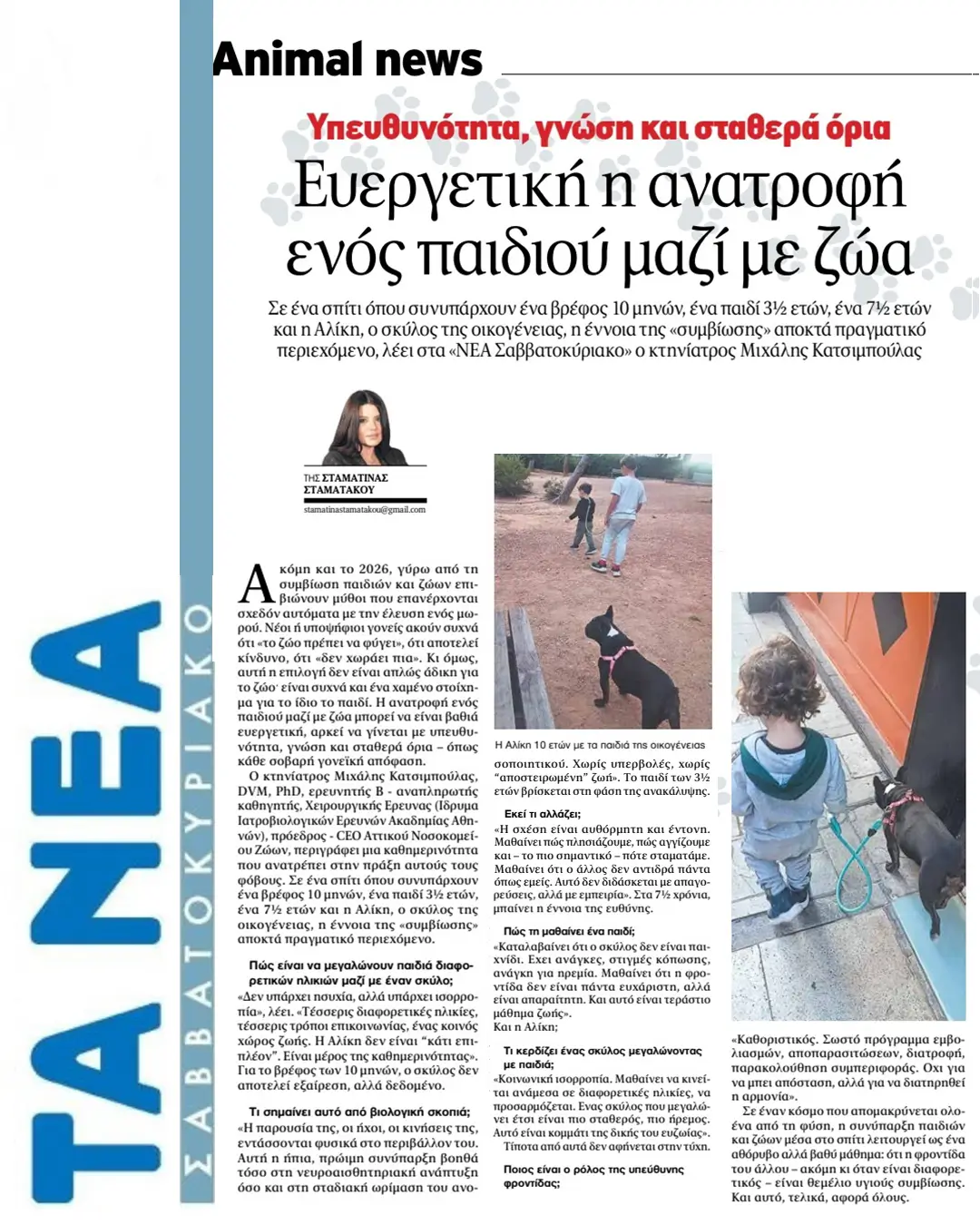
In a house where a 10-month-old infant, a child of 3.5 years, a 7.5 year old and Alice, the dog of the family coexist, the concept of “cohabitation” acquires real content, says veterinarian Michalis Katsiboulas in “NEWS Weekend”.
By Stamatina Stamatakou
Even in 2026, around the symbiosis of children and animals survive myths that recur almost automatically with the advent of a baby. Young or prospective parents often hear that “the animal must leave”, that it is a danger, that it “does not fit anymore”. Yet this choice is not just unfair to the animal; it is often a losing bet for the child himself. Raising a child with animals can be profoundly beneficial, as long as it is done with responsibility, knowledge and firm boundaries — like any serious parenting decision.
Veterinarian Michalis Katsiboulas, DVM, PhD, researcher B - associate professor of Surgical Research (Foundation for Biomedical Research of the Academy of Athens), president - CEO of Attica Animal Hospital, describes an everyday life that subverts these fears in practice. In a house where an infant of 10 months, a child of 3.5 years, a 7.5 year old and Alice, the dog of the family coexist, the concept of “cohabitation” acquires real meaning.
What is it like to raise children of different ages together with a dog?“There is no silence, but there is balance,” he says. “Four different ages, four ways of communicating, a common living space. Alice is not “anything extra”. It is part of everyday life.” For the 10-month-old infant, the dog is not an exception, but a given.
What does this mean from a biological point of view? “Its presence, its sounds, its movements, are naturally integrated into its environment. This gentle, early coexistence aids both neurosensory development and the gradual maturation of the immune. No excesses, no “sterile” life”. The 3.5-year-old is in the discovery phase.
There what changes?
“The relationship is spontaneous and intense. It learns how we approach, how we touch, and — most importantly — when to stop. He learns that the other does not always react the way we do. This is not taught by prohibitions, but by experience.” At 7.5 years, the concept of responsibility comes into play.
How does a child learn it?
“He understands that the dog is not a toy. He has needs, moments of fatigue, a need for calm. He learns that care is not always pleasant, but it is necessary. And that's a huge life lesson.”
What does a dog gain by growing up with children?
“Social balance. He learns to move between different ages, to adapt. A dog that grows like this is more stable, calmer. This is part of his own well-being.” None of this is left to chance.
What is the role of responsible care?
“Definitive. Correct schedule of vaccinations, deworming, nutrition, behavior monitoring. Not to distance themselves, but to maintain harmony.”
In a world increasingly distant from nature, the coexistence of children and animals in the home serves as a silent but profound lesson: that caring for one another — even when different — is the foundation of healthy coexistence. And this, after all, concerns everyone.